Published · Updated
How to start locum work in Singapore

Locum work means filling shifts at clinics on a temporary basis, usually paid by the hour rather than under a salaried contract. It is how many Singapore doctors work flexibly, supplement a main job, or keep clinical hours while doing something else. This guide covers who is eligible, what you need to sort out before your first shift, and the practical admin that comes with it: professional indemnity, tax, and MediSave.
This is general information, not legal or tax advice. Verify your own situation with the Singapore Medical Council, IRAS, or your employer before you act on it.
Check your SMC registration
Everything starts with the type of registration you hold. The Singapore Medical Council maintains four registration types: full, conditional, provisional, and temporary. They are not interchangeable, and only one of them puts ad-hoc private clinic work within reach.
- Full registration allows independent practice. It is the registration that lets you locum freely across clinics. The SMC publishes the criteria and application route for obtaining full registration.
- Conditional registration ties you to an SMC-approved institution and an approved supervisor. Conditionally registered doctors can move toward private practice only at Level 3 supervision, their work cannot include aesthetic practice, and health screening is capped at 20% of caseload. The conditional registration conditions set out the details.
- Provisional registration covers PGY1 doctors and confines practice to approved training hospitals. Ad-hoc private GP locum work is not open to PGY1 doctors.
- Temporary registration is for visiting experts practising for a defined purpose. It is not a route to locum work.
The short version: if you hold full registration with a valid practising certificate, you are eligible. Anything else, check with the SMC before you take a shift.
Keep your practising certificate and CME current
Registration alone is not enough. Practising without registration and a valid practising certificate contravenes Section 17(1)(e) of the Medical Registration Act, as the SMC sets out in its guidance on the practising certificate. A locum shift is practice, so the certificate has to be live on the day you work it.
Practising certificates run for one or two years and always expire on 31 December. Renewal opens up to four months before expiry, so there is a comfortable window if you plan for it. Continuing medical education gates renewal: the CME point requirements are 50 points including 10 core points for a two-year certificate, and 25 points including 5 core points for a one-year certificate.
From 2026, renewals additionally require medical-ethics core points: 5 for a two-yearly renewal and 3 for a one-yearly renewal. If you have been coasting on conference points, check that your ethics component is covered well before December.
If you’re in public healthcare, clear it with your employer first
Public healthcare institutions expect staff to obtain management’s permission before taking locum work elsewhere. MOH’s published position on this, stated in the context of public healthcare institution nurses working as locums, rests on fatigue and patient safety, and the same logic is applied to doctors.
There is an insurance dimension too. MOHH’s medical malpractice insurance FAQ states that its cover does not extend to locum work outside your institution unless that work is specifically approved and the insurer has been notified. Working an unapproved shift can therefore leave you uninsured for it.
Many doctors also report that junior-doctor contracts restrict moonlighting outright. The exact terms are not published and vary by employer, so read your own contract and get approval in writing rather than relying on what a colleague did. For a practitioner’s first-hand account of navigating this, Dr Faith Nadine Choo’s locum FAQ is worth reading.
Sort out professional indemnity
No statute or SMC guideline makes professional indemnity insurance a legal requirement in Singapore. The Singapore Medical Association nonetheless describes adequate indemnity cover as every doctor’s responsibility, and takes the position that no clinic engagement should proceed without it. The SMA lists the Medical Protection Society, Income’s Medical Indemnity Insurance, and the Marsh MEDEFEND scheme as available options.
The point that matters most for locums is that protection attaches to you, not to the clinic. It is the doctor who gets sued or investigated. Do not assume a clinic’s policy covers your shift. Confirm your own cover, and mention locum sessions when you declare your practice profile to your provider, since scope of practice affects both the cover and the premium.
If you are a public-sector doctor, MOHH’s medical malpractice insurance only covers work performed for, or sanctioned by, MOHH or your institution. Private locum sessions fall outside it by default, which is another reason to hold indemnity in your own name.
Arrange cover before you commit to a first shift rather than after. Applications ask about your registration, specialty, and the kind of work you intend to do, and the cover has to be in force on the day you see patients, not merely applied for.
For a comparison of cover types, limits, exclusions, and claims reporting, read the medical indemnity guide for locum doctors.
Understand the tax and MediSave picture
IRAS treats locum income as self-employment income rather than employment income. Its own guidance on corporatisation uses a locum GP as the worked example. You report it under “Trade, Business, Profession or Vocation” in your individual return, Form B or B1, as described in the IRAS pages for self-employed persons and partnerships.
IRAS names unreported locum income as a common filing error, so keep your own record of every shift and fee rather than relying on clinics to report for you. Business records must be kept for at least five years. One structure to avoid: routing locum fees through a company purely to hold them is a documented tax-avoidance target, and IRAS has disregarded such arrangements and assessed the fees on the individual doctor.
MediSave contributions are compulsory for self-employed citizens and permanent residents with net trade income above $6,000 a year. It is the only compulsory CPF contribution on trade income, it is billed after IRAS assesses your return, and contributions attract tax relief. The CPF Board explains the mechanics for saving as a self-employed person. If you are employed and locuming at the same time, you still owe MediSave on the locum income, on top of the CPF your employer already handles.
Practically, this means nobody withholds anything from a locum fee on your behalf. The full amount lands with you, and the tax and MediSave bills arrive later, after the year of assessment. Setting aside a portion of each fee as it comes in is far less painful than finding the money in one go.
Find your first shifts
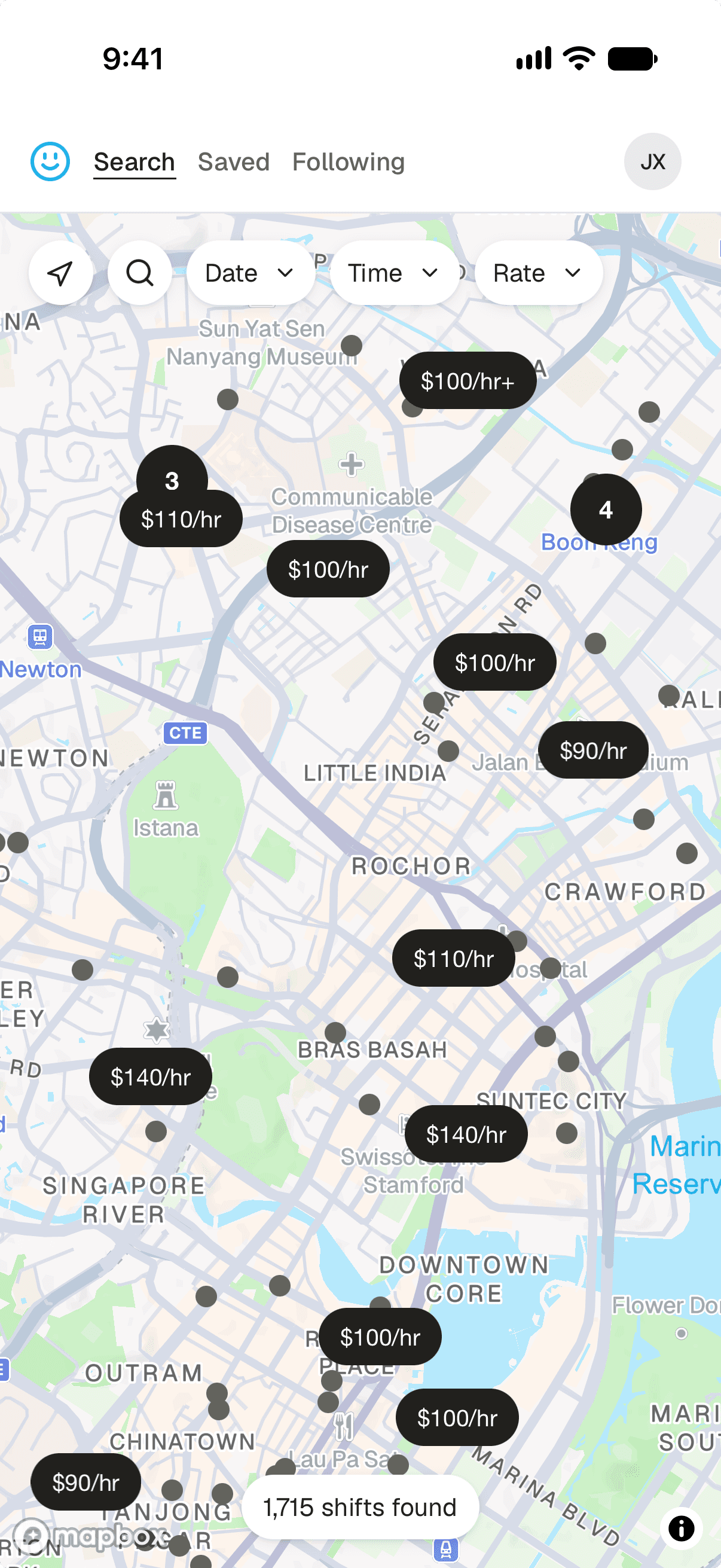
Clinics engage locums either directly or through an agency. Direct engagement means there is no agency cut between the clinic’s budget and your fee, which is usually the better deal for both sides. Rates are typically quoted per hour, and advertised GP rates in Singapore mostly fall between $110 and $140 per hour. See the current rate data for how that varies by day, timing, and setting.
You do not need a healthcare-services licence of your own. Under the Healthcare Services Act, the Outpatient Medical Service licence belongs to the provider operating the clinic, not to the individual doctor working a session there. Your registration, practising certificate, and indemnity are your side of the bargain; the licence, premises, and systems are the clinic’s.
Before you accept a shift, settle the details in writing: the hourly rate and total hours, whether a break is built in, which clinic system the clinic uses, the expected patient load, who else is on site, and when and how you will be paid. None of this is regulated. It is simply the difference between a shift that goes smoothly and one that does not.
If you are still working out whether the arrangement suits you, what is a locum doctor covers the basics.
Ready to find your first shift?
Browse live locum doctor jobs across Singapore, with rates, timings, and clinic details on one map. No account required.